
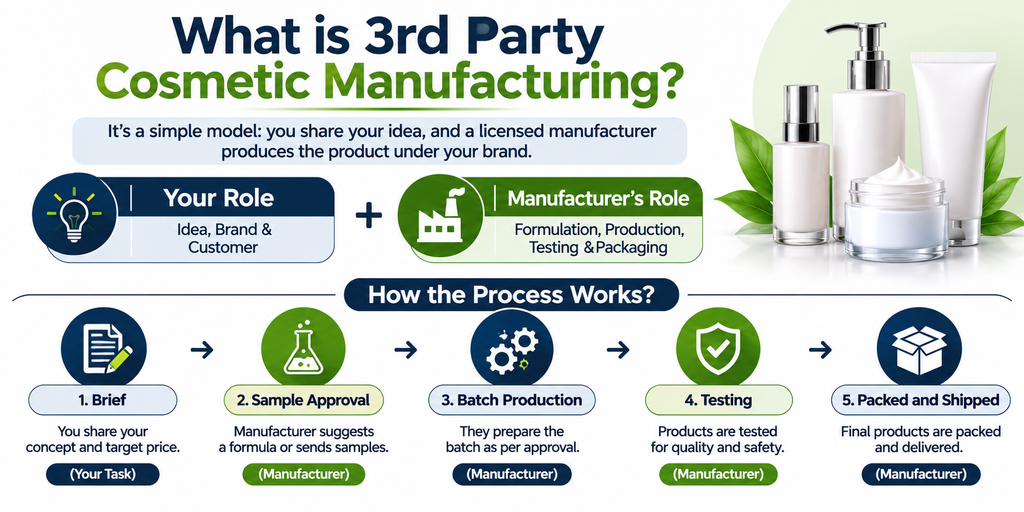
3rd party cosmetic manufacturing means a licensed company produces skincare, haircare or personal care products for you, and you sell them under your own brand. The manufacturer handles formulation, production, testing and packaging. You handle branding, marketing and sales, so no factory is needed.
You don’t need a factory to launch a skincare or haircare brand. With 3rd party cosmetic manufacturing, a licensed facility makes the product and you build the brand. India has hundreds of such manufacturers, and the difference between a good one and a bad one usually shows up only after you’ve paid.
This guide goes past the usual “benefits” list. You’ll get the documents to demand, the red flags to watch for, a real cost breakdown by batch size and the contract terms that protect your formula. If you’d rather see how a working contract manufacturing setup looks in practice, keep reading: Neptune’s own approach is covered near the end.
What is 3rd party cosmetic manufacturing?
Takeaway: 3rd party cosmetic manufacturing is an arrangement where a licensed company makes cosmetics on a brand’s behalf, and the brand sells them under its own name.
The manufacturer owns the plant, the machines and the trained staff. You own the idea, the brand and the customer. The model covers face wash, shampoo, sunscreen, serums, herbal creams and more.
The usual flow is short. You share your concept and target price. The manufacturer proposes a ready formula or develops a custom one and sends samples. You approve a sample. Then the team buys raw materials, makes the batch, tests it, fills it, packs it and ships it, often with labels and cartons already on.
Third-party, contract, private label, OEM and ODM
Takeaway: Third-party manufacturing is the umbrella term; contract (OEM) means the manufacturer makes your formula, while private label and ODM mean you rebrand a formula the manufacturer already owns.
These terms get used loosely, and the confusion costs people money because each one answers a different question: whose formula is it?
| Term | What happens | Who usually owns the formula |
|---|---|---|
| Third-party manufacturing | Umbrella term for outsourcing production | Depends on the agreement |
| Contract manufacturing / OEM | Manufacturer produces to your specification or your formula | Usually you |
| Private label | You pick a ready formula and add your brand | Usually the manufacturer |
| ODM | Manufacturer develops the product, you rebrand it | Usually the manufacturer, unless the contract says otherwise |
One third party cosmetics company may offer all four. Ask which one you’re buying, and get ownership and confidentiality in writing before development starts.
Is this model right for your brand?
Takeaway: 3rd party cosmetic manufacturing suits startups, D2C brands, creators and existing brands adding a line, but it’s a poor fit if you need total control over every production step.
It fits well if you want to launch without building infrastructure, you want chemists to handle stability and safety, or you plan to scale in stages. It fits badly if your formula is so sensitive that you won’t share it with anyone, or if you intend to run your own plant within a year or two. In that case a contract-manufacturing agreement with strong technology-transfer terms matters more than anything else.
Why is it growing in India?
Takeaway: Outsourced cosmetic manufacturing is growing in India because the market is expanding, entry costs are lower, and online selling lets small brands reach buyers nationwide.
According to IMARC Group, India’s beauty and personal care market was valued at USD 31.19 billion in 2025 and is projected to reach USD 48.72 billion by 2034, a compound annual growth rate of 5.08%. More buyers mean more brands, and most new brands won’t build plants.
Habits are shifting too. Serums and sunscreens that once sold only in metros are now requested in smaller cities. Meanwhile a licensed plant needs land, machinery, utilities, approvals and a skilled team before the first unit sells, so outsourcing lets a brand launch with a modest batch and keep cash for marketing. Add chemists you don’t have to hire, plus marketplaces where you can build an audience first and order production as sales come in, and the appeal is obvious.
What can a manufacturer make for you?
Takeaway: Most manufacturers cover skincare, haircare, personal care and herbal ranges, while makeup and sunscreens demand more specialised capability.
| Category | Common products | What to know |
|---|---|---|
| Skincare | Face serums, face wash, face scrubs, moisturising and cold creams, hydrating lotions, peel-off masks | Most popular category; many ready formulas |
| Haircare | Shampoos, hair serums, conditioners, hair oils, masks | Fragrance and texture drive repeat purchases |
| Personal care | Shower gels, body washes, deodorants | Good for a full bath and body range |
| Sunscreen | Sunscreen lotions and creams, sunblock gels | Technical; ask for stability and performance data |
| Makeup | Foundations, lipsticks, compact powders | Needs shade matching; fewer manufacturers offer it |
| Herbal and Ayurvedic | Face packs, creams, oils | Check ingredient sourcing and your label claims |
Beyond these, baby care, intimate hygiene and men’s grooming ranges are common requests, and a good manufacturer should be able to tell you honestly which of them it already runs.
Licences and standards that matter in India
Takeaway: In India, ask for the cosmetic manufacturing licence issued under the Cosmetics Rules, 2020, and for GMP evidence such as ISO 22716, which is the international GMP standard written specifically for cosmetics.
Two points trip people up.
First, a licence is not a quality guarantee. It tells you the facility is permitted to manufacture your product type. It doesn’t tell you how well it runs. Check validity and scope, then judge the plant itself.
Second, not every certificate is about cosmetics. Many Indian manufacturers display WHO-GMP, which is a pharmaceutical standard. It isn’t wrong to hold one, but it doesn’t replace cosmetic GMP evidence. Ask what each certificate covers, which site it applies to and when it expires. A certificate for a sister pharma unit says nothing about the line making your cream.
Cosmetics also sit under a legal line. Under India’s Drugs and Cosmetics framework, a product that claims to treat or cure a disease can fall into the drug category. So claims like “cures dandruff” or “treats acne” need careful review before they reach your label. Have a regulatory consultant or your manufacturer’s compliance team check your claims early. A manufacturer should also be open about its compliance setup; Neptune, for example, describes its approach on a dedicated certifications page.
How to choose a manufacturer: 10 checks
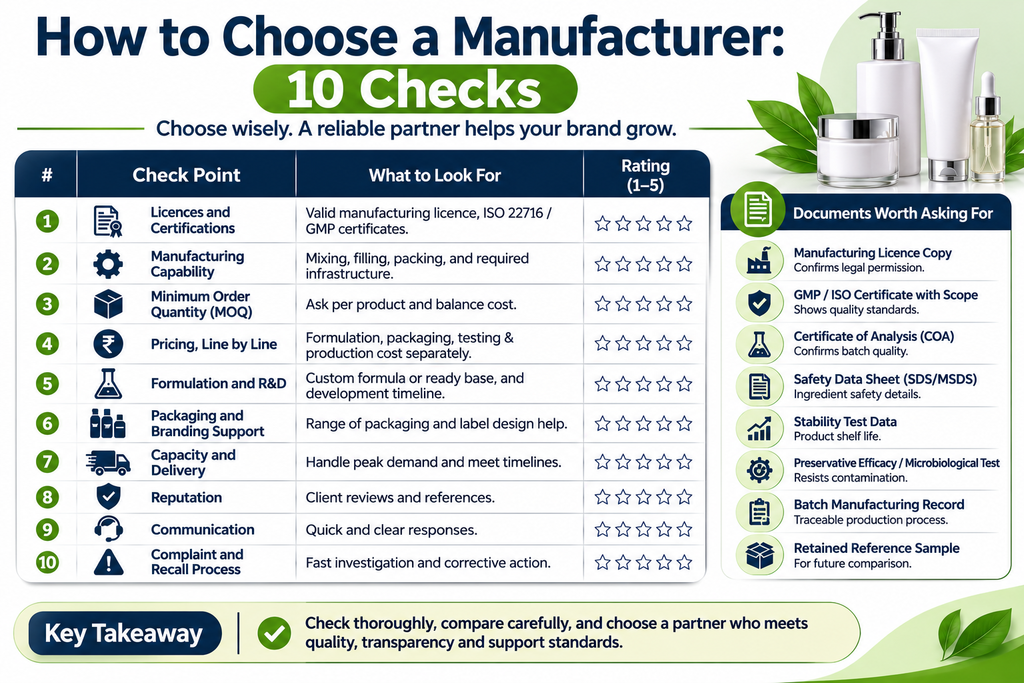
Takeaway: Choose a manufacturer by verifying licences first, then capability, MOQ, line-by-line pricing, formulation skill, packaging support, capacity, reputation, communication and recall handling.
One bad batch can sink a young brand, so treat this as due diligence, not shopping. The checks below run roughly in order of importance.
1. Licences and certifications
Ask for the manufacturing licence and confirm it’s valid and covers your product type. Request ISO 22716 or equivalent GMP evidence, and get copies, not just logos on a website. Then visit the plant or take a live virtual tour. If a manufacturer resists, treat that as your answer.
2. Manufacturing capability
See what they already make, and look at the mixing, filling and packing equipment. A cream and a shampoo need different equipment. Ask about compounding vessels, temperature control, filling and batch-coding lines, air handling and water treatment, because water quality quietly decides how stable a formula stays. Ask whether they can run a small trial batch and a large repeat order. You can see how one facility describes this on Neptune’s infrastructure page, which is the kind of detail you should expect from any shortlisted partner.
3. Minimum order quantity (MOQ)
MOQ varies by formula, packaging and product type, so ask per product. A low MOQ helps cash flow, but it raises cost per unit, so look at both together.
4. Pricing, line by line
Get written quotations and compare formulation, packaging, testing and production separately. Ask about charges for custom formulas, revisions and artwork changes. The right price is the one that leaves you a healthy margin after every cost.
5. Formulation and R&D
Ask whether the team builds from your brief or rebadges a common base. Both are legitimate, but you should know which you’re paying for. Ask how long development takes and what it costs. A structured formulation development process should cover requirement analysis, formula design and laboratory testing for stability, texture, fragrance and compatibility. If you want something new rather than a tweak, ask about research and development and new product development support.
6. Packaging and branding support
Find out if they supply packaging or expect you to source it. Review the bottles, jars, tubes and pumps on offer, and ask about label design help. Check who pays for leftover packaging if you change a design. Look at what packaging solutions the manufacturer actually offers before you commit to a design.
7. Capacity and delivery
Stock-outs in peak season hurt. Festive periods and summer sunscreen demand strain any plant, so ask how they handle seasonal peaks and what lead time repeat orders get.
8. Reputation
Read reviews, and also ask for references you can phone. A manufacturer experienced in your category already knows its usual problems. Long client relationships are a good sign.
9. Communication
Watch how fast and how directly the team answers in early talks. That habit rarely improves once you’ve paid. Ask for regular production updates.
10. Complaint and recall process
Ask what happens when a batch has a problem, and ask before you sign. A good manufacturer investigates fast, shares findings and corrects the cause. Ask to see how its quality control runs from raw material inspection through in-process testing to final product evaluation.
Documents worth asking for
| Document | What it tells you |
|---|---|
| Manufacturing licence copy | The facility is permitted to make your product type |
| GMP / ISO certificate with scope | What the certificate actually covers |
| Certificate of Analysis (COA) per batch | The batch met its specification |
| Safety Data Sheet (SDS/MSDS) for ingredients | Handling and ingredient safety information |
| Stability test data | How the product holds up over time and in different conditions |
| Preservative efficacy / microbiological test | Whether the formula resists contamination |
| Batch manufacturing record | A traceable record of how your batch was made |
| Retained reference sample | A sample kept for comparison if a complaint arrives |
Marketplaces, distributors and exporters often ask for several of these, so getting them from day one saves rework later.
Red flags to walk away from
Takeaway: Refusing a plant visit, giving no itemised quote, guaranteeing results or asking for a large advance with no written agreement are warning signs of a risky manufacturer.
- They won’t show the licence or let you see the facility.
- The quote is a single number with no breakdown.
- They promise “100% results” or medical outcomes for a cosmetic.
- They can’t produce a COA or stability data when asked.
- The bulk batch looks or smells different from the approved sample, and they shrug it off.
- They push a large advance payment before any written terms exist.
- Everything is “possible” and nothing is documented.
Any one of these alone isn’t fatal. Two or three together mean you should keep looking.
What does it cost? A worked example
Takeaway: Cost depends on the product, batch size and packaging, and only written manufacturer quotations give exact numbers, because a basic face wash costs far less than an active serum in an airless pump bottle.
| Cost component | What it covers | What pushes the price up |
|---|---|---|
| Raw materials | Base ingredients, actives, preservatives, fragrance | Premium actives, herbal extracts, imported ingredients |
| Formulation development | Creating or adjusting a formula, sample batches | Custom formulas, many revisions, unique claims |
| Production and filling | Mixing, filling, sealing, labour | Complex textures, very small batches |
| Packaging and labelling | Bottles, jars, tubes, cartons, labels | Custom moulds, airless pumps, premium printing |
| Testing and quality control | Raw material, stability, microbiological checks | Extra tests, third-party lab reports, special claims |
| MOQ and volume | Size of the batch | Low volumes raise cost per unit |
Example: 30 ml serum, per-unit cost at a 1,000-unit batch. These figures are assumptions for illustration only. Your quotation will differ.
| Item | Cost per unit (₹) |
|---|---|
| Raw materials | 55 |
| Production and filling | 15 |
| Bottle and carton | 30 |
| Label and printing | 6 |
| Testing and quality control | 4 |
| Total | 110 |
Now the part most guides skip: batch size changes your real cost per unit, because one-time costs get spread over fewer bottles. Assume one-time costs of ₹40,000 (formulation and design, illustrative) and unit costs that fall as volume rises.
| Batch size | Unit cost (₹, assumed) | Batch cost (₹) | One-time costs (₹) | All-in cost per unit (₹) |
|---|---|---|---|---|
| 500 | 130 | 65,000 | 40,000 | 210 |
| 1,000 | 110 | 1,10,000 | 40,000 | 150 |
| 5,000 | 90 | 4,50,000 | 40,000 | 98 |
A 500-unit batch costs less cash today but about twice as much per bottle as a 5,000-unit batch. The right batch is the one you can sell through before the shelf life gets uncomfortable, not the cheapest per unit.
Hidden costs people forget: artwork revisions, sample courier charges, third-party lab tests, pallet or freight charges, leftover packaging stock and a reprint buffer. Add launch costs such as photography, a website and marketing on top.
Your budget formula is: one-time costs + (unit cost × quantity) + launch costs + a buffer.
What your contract must cover
Takeaway: A cosmetic manufacturing contract should state formula ownership, confidentiality, quality specifications, MOQ, pricing terms, recall responsibility and what happens if the relationship ends.
Handshake deals are where brands lose formulas. Before you sign, confirm in writing:
- Formula ownership and whether the manufacturer may sell the same formula to others.
- Confidentiality of your formula, brief and artwork.
- Exclusivity, if you want it, for a product or category.
- Quality specification that the approved sample sets, with tolerances.
- MOQ, lead times and price-revision rules for repeat orders.
- Packaging ownership and who bears the cost of obsolete stock.
- Batch rejection, complaint and recall responsibilities.
- Payment schedule tied to milestones, not just an advance.
- Exit terms, including whether you can move production elsewhere with your formula.
If any of this feels heavy for a small brand, a lawyer’s one-hour review costs far less than a lost formula.
Launch roadmap
Takeaway: Launch in order: define the product, shortlist manufacturers, approve a sample, finish compliance and artwork, then place the first order.
- Identify your target customer and product category.
- Research the market and your competitors.
- Finalise specifications and formulation direction.
- Shortlist three manufacturers and run the ten checks.
- Request samples and test them on skin, for shelf life and for packaging compatibility.
- Finalise packaging, pricing and branding.
- Complete regulatory and documentation work, including label content and claims review.
- Place a first order sized to your real sales forecast.
- Plan distribution, marketing and the first re-order.
Don’t rush step 5. The approved sample becomes the standard for every future batch, so a weak sample approved in a hurry follows you for years.
Mistakes that quietly kill new brands
- Choosing on price alone. A cheap quote often hides skipped tests or later charges.
- Skipping stability data. A cream that looks perfect today can separate or change colour in months.
- Approving one sample and never checking later batches. Test samples from more than one batch.
- Printing claims you can’t support. Over-claiming is the fastest route to a compliance headache.
- Ordering too much, too early. Unsold stock ages, and cash tied up in bottles can’t fund marketing.
- No written agreement on the formula. You find out who owns it only when you try to leave.
Working with Neptune Health & Beauty Care
Takeaway: Neptune Health & Beauty Care Pvt Ltd is a third party cosmetics company at EPIP, Baddi, Himachal Pradesh, offering private label and third-party manufacturing for skincare, hair care, personal care, baby care, intimate hygiene and men’s grooming brands.
Everything in this guide is meant to help you judge any manufacturer, Neptune included. Here is what the company says about itself, so you can hold it to the same checklist.
Services. Neptune offers product consultation and formula development, manufacturing, filling, packaging, labelling and quality assurance. Its About Us page explains the company background. The team works from your specifications and also develops customised formulations, as set out on the formulation development page.
Products. The range includes face serum, face wash, face scrub, shampoo, hair growth serum, shower gel, moisturising cream, peel-off mask, hydrating lotion, soap-base face wash, sunblock gel and sunscreen lotion and cream. Its contract manufacturing page also lists men’s grooming items such as beard oils and shaving products.
Plant. According to its infrastructure page, the facility uses stainless steel compounding vessels with digital temperature control and variable-speed emulsifiers, automated filling, capping and batch-coding lines, continuous HVAC air filtration and a multi-stage reverse osmosis and deionisation water treatment setup.
Quality. Its quality control page describes checks from raw material inspection through in-process testing to final product evaluation, with testing for stability, safety, appearance and performance. The certifications page says processes run in line with current GMP and ISO quality benchmarks.
As with any manufacturer, ask for the licence copy and the certificate copies with their scope when you enquire. That’s the same standard this guide asks you to apply everywhere.
Ready to talk? Share your product idea and target price through the contact page, call +91 8091333552 or email info.neptunelifesciences@gmail.com. You can also browse more guides in the Neptune blog.
Conclusion
Choose the manufacturer that gets quality, documentation, pricing and capability right together, not the one with the lowest quote. A cheap price means nothing if the product fails a stability test or the licence has lapsed.
Before you pay anything: verify the paperwork, visit or video-tour the plant, test samples from more than one batch and put the commercial terms and formula ownership in writing. Do that and third party cosmetic manufacturing gives you a professional product, a lower starting cost and the freedom to build your brand.
Key Takeaways
- 3rd party cosmetic manufacturing lets you sell products made by a licensed outside facility, with no factory needed.
- Contract (OEM) usually means you own the formula; private label and ODM usually mean the manufacturer does. Confirm in writing.
- Verify the licence under the Cosmetics Rules, 2020, and cosmetic GMP evidence such as ISO 22716. WHO-GMP is a pharma standard.
- Ask for COA, SDS, stability and preservative efficacy data before you commit.
- Batch size changes real cost per unit; one-time costs weigh heavily on small batches.
- Review claims and labels early so a cosmetic doesn’t read like a drug.
FAQs
What is third party cosmetic manufacturing?
It’s a business model where a brand outsources production of its cosmetic products to an outside licensed factory and sells them under its own name.
What is the difference between third-party, contract and private-label manufacturing?
Third-party is the umbrella term. Contract manufacturing means the factory makes to your specification or formula, while private label means you rebrand a formula the factory already owns.
How much does it cost to start a cosmetic brand with a third party manufacturer?
It depends on the product, batch size, packaging and one-time costs. Use the formula one-time costs plus unit cost × quantity plus launch costs, and compare written quotations.
Who owns the formula?
That depends on your agreement. Settle ownership, exclusivity and confidentiality in writing before development begins.
Can I make a custom formula?
Many manufacturers offer custom formulation, including Neptune. Ask about development time, sample charges, revision limits and any extra fees.
Can startups order small batches?
Some manufacturers support low quantities. Ask for the MOQ per product, since a cream and a shampoo can differ, and compare the all-in cost per unit.
Which certificates should a cosmetic manufacturer have?
Ask for the manufacturing licence under the Cosmetics Rules, 2020, and GMP evidence such as ISO 22716. Check the scope and validity of every certificate.
Do I need my own manufacturing licence to sell cosmetics?
The manufacturing licence is held by the manufacturer. Check with a regulatory consultant or chartered accountant for other registrations that apply to your business, such as GST and trademark.
Can I make herbal or Ayurvedic cosmetics?
Yes, many manufacturers offer these ranges. Check ingredient sourcing and be careful with the claims you print on the label.
Should I choose the cheapest manufacturer?
Not by default. Low prices can hide weak testing, poor packaging or charges that appear later. Compare the full quotation and the quality systems.
What happens if a batch has a problem?
Ask for the complaint and recall process before you sign. A good manufacturer investigates quickly, shares findings and corrects the cause.
Why is sample approval important?
The approved sample becomes the standard for every future batch. Test it on skin, for shelf life and for packaging compatibility first.
Does Neptune offer private label and third-party manufacturing?
Yes. Neptune says it offers private label and third-party manufacturing along with customised formulations. Start with the contact page.
How can I contact Neptune Health & Beauty Care?
Call +91 8091333552 or email info.neptunelifesciences@gmail.com. The facility is at Plot No. 100 B, EPIP, Phase II, Thana, Baddi, Solan, Himachal Pradesh 173205.
Author Box
Neptune Health & Beauty Care Pvt Ltd
A third party cosmetics company at EPIP, Baddi, Himachal Pradesh, offering product development, formulation, manufacturing, filling, packaging, labelling and quality assurance for skincare, hair care, personal care, baby care, intimate hygiene and men’s grooming brands. Visit neptunebeautycare.com
