
Featured Snippet Box
Third-party cosmetic and beauty product manufacturing in India is priced per unit. Marketplace listings run from about ₹25 to ₹200, depending on product type, ingredients and pack size. Most manufacturers ask for 500–5,000 units per product. Packaging, testing, licensing and label design usually cost extra.
Here’s the answer up front. The cost of third-party cosmetic and beauty product manufacturing in India is a per-unit price plus a handful of extras, and the extras are where budgets break.
Public listings give a rough picture. Third-party cosmetic items appear at ₹25 for a 12 gm product up to ₹75 for a 50 ml colour cosmetic, while some private label creams are listed at ₹200 per piece. That’s a wide gap, and a listing can’t tell you why. It rarely states fill size, ingredients or packaging.
So this guide does something different. Instead of quoting a “typical price”, it shows what drives the number, how to read a quote, and where cosmetic manufacturing cost in India quietly grows after you’ve agreed on a rate. It’s written by the team at Neptune Health & Beauty Care Pvt Ltd, a third-party cosmetic manufacturer based in Baddi, Himachal Pradesh, so you’ll also see how the points apply when you talk to a real manufacturer.
What it costs, in plain terms
Third party cosmetic manufacturing cost in India has two parts: a per-unit price for the product, and one-time or yearly costs for licensing, testing and design.
Per-unit covers the formula, filling and labelling. Everything else (loan licence, stability testing, artwork, sample rounds) sits outside it. A founder who compares only the first part will always feel the second part as a surprise.
The cost ladder: which products cost more
Beauty product manufacturing cost in India rises with formula complexity. A body wash costs less to make than a serum, and a serum costs less than a sunscreen that must stay stable.
| Product type | Examples | Where it sits | Why |
|---|---|---|---|
| Wash-off personal care | Shampoo, shower gel, face wash | Lower | Simple base, standard bottle |
| Basic leave-on | Moisturizing cream, hydrating lotion | Lower to medium | Emulsion stability matters |
| Rinse and mask formats | Face scrub, peel-off mask | Medium | Texture and filling needs |
| Active skincare | Face serum | Medium to high | Active ingredients, pH, protective pack |
| Sun care and treatment-style products | Sunscreen cream, hair growth serum | Highest | Heavier testing and regulatory care |
Pay attention to the last row. A product that makes treatment claims or contains an ingredient regulated as a drug may fall under drug rules instead of cosmetic rules. That changes the licence route and the cost. Ask your manufacturer in writing which category your formula and claims fall under, and get a regulatory professional’s view before you print a claim on the box.
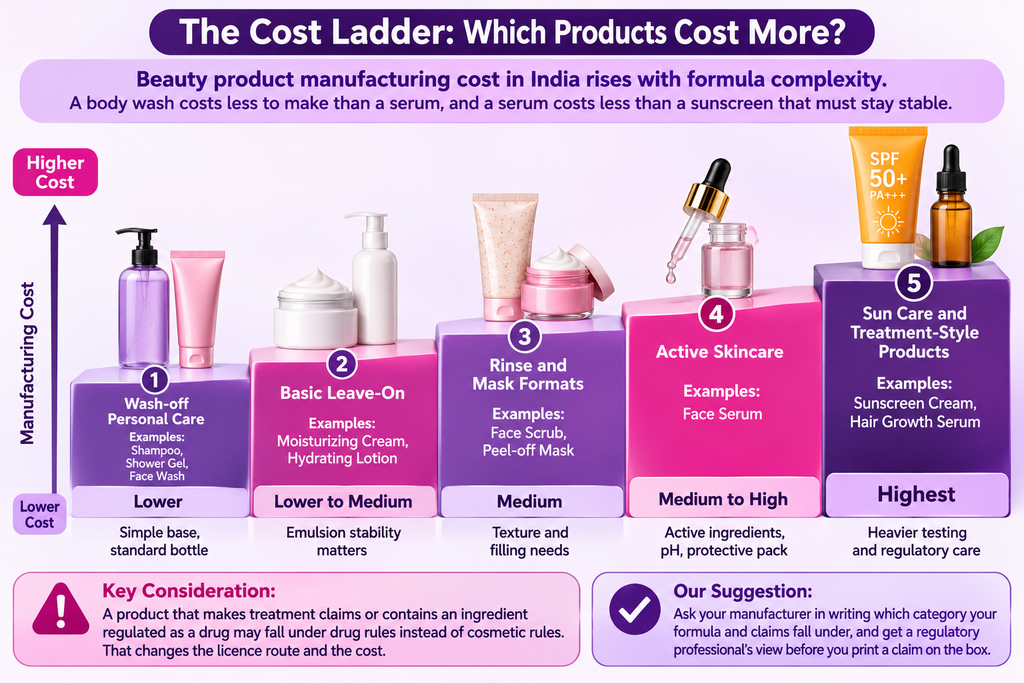
[Visual / Diagram Suggestion: A ladder or staircase graphic showing the five product types from lower to higher cost.]
Five cost heads behind every quote
Every quote for skincare product manufacturing in India comes down to five things: ingredients, packaging, process, testing and margin. Know them and you can spot what a quote leaves out.
- Ingredients. Actives like niacinamide, salicylic acid, ceramides or hyaluronic acid push cost up, as do premium grades and higher percentages. This is also where formulation development charges can appear if you want a custom formula.
- Packaging. Often the biggest swing. A plain jar and a glass airless pump are in different price worlds. This covers cartons and leaflets too. Ask whether the manufacturer offers packaging solutions in-house or expects you to source them.
- Process. Mixing, homogenising, filling, sealing. Small batches cost more per unit because setup time is spread over fewer pieces.
- Testing. Stability, microbial and compatibility checks. Skipping them saves money until a batch separates. See how a manufacturer describes its quality control process before you compare prices.
- Margin. The manufacturer’s overhead and profit. Negotiable once your volumes grow.
MOQ: why 1,000 units can cost more than 5,000
Minimum order quantity (MOQ) is the smallest batch a manufacturer will make for one product. A larger batch lowers the per-unit price but raises your cash outlay and stock risk.
One private label skincare supplier says MOQs commonly fall around 500–1,000 units per product for creams and lotions, with small-batch options available at a higher price. Others promote low-MOQ runs of about 1,000–5,000 units for startups, and several listings show minimums of 1,000 to 2,000 units.
Now the part people skip. The lowest unit price is rarely the cheapest decision for a new label. If 5,000 jars of one cream save you ₹8 each but take a year to sell, you’ve paid for storage, expiry risk and a stuck budget. Two or three products at 500–1,000 units each cost more per piece, but they show you what the market wants before you commit.
The exception is simple: if you already have a distributor or retail order, the bigger batch wins.
Three launch scenarios
The scenarios below are illustrations with assumed figures, not market data. Use them to see how decisions change cost, then replace the numbers with real quotes.
| Scenario A: Test the market | Scenario B: Build a small range | Scenario C: Go to retail | |
|---|---|---|---|
| Products | 1 | 3 | 5+ |
| Units per product | 500–1,000 | 1,000 | 3,000–5,000 |
| Formula | Private label base | Private label with tweaks | Custom |
| Per-unit cost | Higher | Medium | Lower |
| Upfront cash | Lowest | Medium | Highest |
| Main risk | Weak margins at small scale | Slow stock movement | Unsold inventory |
The pattern matters more than any figure. As units go up, per-unit cost falls but the cash you lock up rises. Pick the scenario that matches your funding and your sales channel, not the one with the prettiest unit price.
Licences and compliance
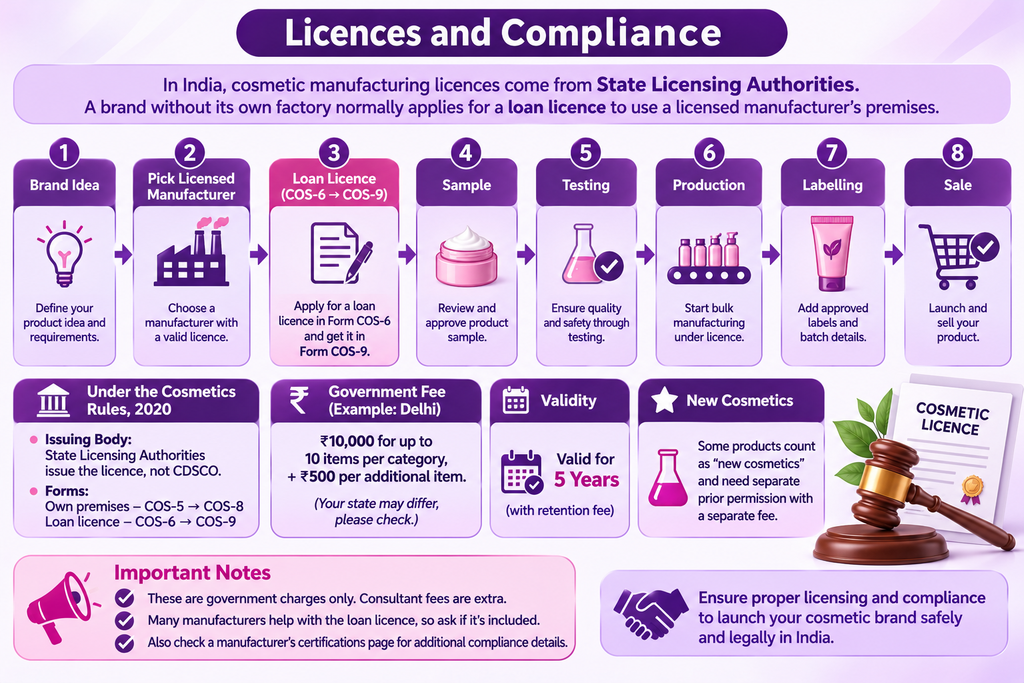
In India, cosmetic manufacturing licences come from State Licensing Authorities. A brand without its own factory normally applies for a loan licence to use a licensed manufacturer’s premises.
Under the Cosmetics Rules, 2020:
- Issuing body: State Licensing Authorities issue the licence, not CDSCO.
- Forms: A manufacturer with its own premises applies in Form COS-5 and gets a licence in COS-8. A loan licence is applied for in Form COS-6 and granted in Form COS-9.
- Government fee: The Delhi drug control department’s schedule shows ₹10,000 for up to ten items per category, and ₹500 per additional item. Your state may differ, so check it.
- Validity: The licence stays valid while a retention fee is paid every five years.
- New cosmetics: Some products count as “new cosmetics” and need separate prior permission with a separate fee.
Those are government charges only. If you hire a consultant for paperwork, that’s extra. Many manufacturers help with the loan licence, so ask whether it’s included before you compare prices. You can also review a manufacturer’s certifications page to see what it publishes.
Licences and compliance
In India, cosmetic manufacturing licences come from State Licensing Authorities. A brand without its own factory normally applies for a loan licence to use a licensed manufacturer’s premises.
Under the Cosmetics Rules, 2020:
- Issuing body: State Licensing Authorities issue the licence, not CDSCO.
- Forms: A manufacturer with its own premises applies in Form COS-5 and gets a licence in COS-8. A loan licence is applied for in Form COS-6 and granted in Form COS-9.
- Government fee: The Delhi drug control department’s schedule shows ₹10,000 for up to ten items per category, and ₹500 per additional item. Your state may differ, so check it.
- Validity: The licence stays valid while a retention fee is paid every five years. chemlinked
- New cosmetics: Some products count as “new cosmetics” and need separate prior permission with a separate fee.
Those are government charges only. If you hire a consultant for paperwork, that’s extra. Many manufacturers help with the loan licence, so ask whether it’s included before you compare prices. You can also review a manufacturer’s certifications page to see what it publishes.
Private label vs custom formula
Private label means a manufacturer’s ready formula under your brand. A custom formula is built or modified for you. Private label is quicker and cheaper to start. Custom is harder to copy and costs more.
| Factor | Private label | Custom formula |
|---|---|---|
| Formula | Ready, may be shared with other brands | Built for you |
| Time to market | Shorter | Longer |
| R&D cost | Low or none | Higher |
| Uniqueness | Limited | Strong |
| MOQ | Often lower | Often higher |
| Good for | Testing demand | A signature product |
Private label beauty products manufacturing gets you on the shelf fast. Private label cosmetic products manufacturing works the same way, but ask whether other brands already sell the same base, because that affects how special your product can be. With third party beauty product manufacturing on a custom formula, you pay more upfront for something a competitor can’t order next week. Custom work usually starts with new product development and a brief on your target customer.
A middle path is common. Beauty products third party manufacturing in India often starts with a private label base, then changes fragrance, texture or actives once the first batch sells. Neptune Health describes its contract manufacturing service as covering both private label and customised formulations.
One warning: suppliers use “private label”, “white label” and “third party” loosely. Get formula exclusivity in writing.
Costs that show up late
Most overruns in cosmetic product manufacturing cost in India come from changes and repeats, not from the original quote.
- Sample revisions. The first sample may be free. The third rarely is.
- Packaging minimums. Your bottle can have a bigger MOQ than your formula.
- Failed stability. A cream that separates in warm storage means a redo.
- Label errors. Found after printing, they mean reprinting.
- Tax, freight, storage. Quotes are often ex-factory.
- Expiring quotes. Raw material prices move, so a quote may hold for only a few weeks.
- Retesting. A new fragrance or preservative is effectively a new formula.
How to read and compare quotes
Compare landed cost per sellable unit, not the headline rate. Landed cost means everything it takes to get one finished, labelled, packed unit ready to sell.
Ask each manufacturer the same ten questions:
- What fill size and pack are you quoting?
- Is packaging included, and with what MOQ?
- What are the active ingredients and their percentages?
- How many samples and revisions are free?
- Which tests are included?
- Do you help with the loan licence?
- What are payment terms and lead time?
- How long is the price valid?
- Who owns the formula?
- What will a reorder cost?
If two quotes answer these differently, they aren’t comparable yet.
Choosing a manufacturer
A reliable cosmetic manufacturing company in India holds a valid licence, follows GMP under the Cosmetics Rules, quotes in detail and puts formula ownership in writing.
There are plenty of beauty and cosmetic manufacturers in India, and quality varies a lot. A few checks separate the good ones fast:
- Licence. Ask for a copy, then confirm it with the state authority.
- GMP. Under the Seventh Schedule, GMP is a mandatory prerequisite for licence approval. Treat claims like WHO-GMP or ISO as items to verify, not assume.
- Category fit. A factory that’s great at hair oil may not handle stable active serums. Ask for products similar to yours.
- A plant visit. Even a video call walkthrough tells you plenty. A manufacturer’s infrastructure page is a good starting point before you visit.
- The contract. Formula ownership, exclusivity, batch records and recall responsibility.
Price should be the last filter, not the first.
If you want to see how this plays out with a real manufacturer, Neptune Health & Beauty Care Pvt Ltd works from Baddi, Himachal Pradesh, across skincare, haircare and personal care. You can browse its product range and then contact the team with your product idea and target quantity to get an itemised quote.
When third-party manufacturing is the wrong move
Outsourcing isn’t always the best route. It makes less sense in three cases.
- You need full control over a unique, trade-secret formula and don’t trust any contract partner with it.
- Your volumes are so large that owning a plant would clearly beat a manufacturer’s margin.
- Your product is a novel ingredient or claim that needs special permissions a third party can’t handle for you.
For most new brands, though, third-party manufacturing remains the lower-risk way to start.
Key Takeaways
- Cosmetic and beauty manufacturing is priced per unit, and listings range widely. Get itemised written quotes.
- Packaging, testing and compliance can rival the cost of the formula.
- MOQs commonly run 500–5,000 units. The cheapest unit price isn’t always the right choice for a new brand.
- Brands without a factory typically use a loan licence (COS-6 application, COS-9 licence) from the State Licensing Authority.
- Products with treatment claims may fall under drug rules. Confirm early.
- Judge quotes on landed cost per sellable unit.
Before you ask for a quote, decide your scenario: test, small range or retail. It will tell you what MOQ, formula type and budget to ask for. When you’re ready, send your requirement to Neptune Health and ask for a line-by-line breakdown.
FAQs
1. What is the third party cosmetic manufacturing cost in India?
It depends on formula, packaging and quantity. Public listings show roughly ₹25–₹200 per piece, but a product with premium ingredients and packaging can cost more. Ask for itemised quotes.
2. What is the beauty product manufacturing cost in India for a startup?
A startup pays for per-unit manufacturing, packaging, a loan licence, testing and label design. The total depends on how many products and units you start with.
3. What is the MOQ for third-party beauty product manufacturing?
About 500–1,000 units per product for creams and lotions at some manufacturers, and 2,000–5,000 at others. For Neptune Health’s current MOQ on a specific product, contact the team.
4. Do I need my own licence for private label cosmetic products manufacturing?
If you sell under your own brand, you typically need a loan licence (COS-6 application, COS-9 licence) unless the manufacturer’s arrangement covers your sale. Check with your State Licensing Authority.
5. What is the government fee for a cosmetic manufacturing or loan licence?
According to the Delhi drug control department’s schedule, ₹10,000 for up to ten items per category and ₹500 for each additional item. Confirm with your state.
6. Is private label cheaper than a custom formula?
Usually yes at the start, because R&D cost is low or zero. Custom costs more but gives you a product no one else sells.
7. Why do quotes for the same product differ so much?
Ingredient grade, packaging, included testing and margins all differ. Compare like with like.
8. Can I start with a small batch?
Some manufacturers offer small batches or sample orders, though per-unit prices are higher.
9. Does a lower price mean lower quality?
Not always, but very low quotes often leave out packaging, testing or quality checks. Ask what’s included.
10. How do I find a reliable cosmetic manufacturing company in India?
Verify the licence, ask about GMP and similar past products, request samples, and write formula ownership and testing terms into the contract.
Author Box
Neptune Health & Beauty Care Pvt Ltd is a third-party and private label manufacturer of skincare, haircare and personal care products, based at Plot No. 100 B, EPIP Phase II, Thana, Baddi, Solan, Himachal Pradesh. Explore its contract manufacturing, formulation development and quality control services.
